
Video API vs Traditional Video Production: 2026 Cost Comparison
Agency video runs $1,000–7,000 per finished minute (Synthesia, 2025). Template APIs render the same minute for $0.10–0.20. The real cost math, tier by tier.

Founder
Let's talk numbers, because the gap is larger than most teams realize.
Your marketing team needs 500 personalized product demo videos for enterprise customers. The traditional route: $50,000+ and a 3-month timeline. The API route: roughly $250 in credits and a single afternoon. That's not a clever framing. It's what the cost math does once you remove the editing labor.
Agency-produced video still runs $1,000–7,000 per finished minute depending on scope (Synthesia, 2025). A template-based API renders that same minute for $0.10–0.20. This guide breaks down the real cost math, including the hidden costs nobody puts in the proposal, so you can decide where each approach belongs in your stack.
Key Takeaways
- Agency video production runs $1,000–7,000 per finished minute in 2026 (Synthesia, 2025); template-based APIs render a minute for $0.10–0.20
- At 100 videos our model puts agency production at $74,000 against $470 via API, a 99.4% reduction; at 1,000 videos it's $240,000 against $820
- The decisive line item is internal hours, not the invoice: 35+ hours of PM, review, and compliance work per video that no agency bills you for
- 91% of businesses now use video as a marketing tool (Wyzowl, 2026), so the volume pressure is not going away
- API beats agency on cost from the first video, but only for work that fits a template. Hero films still belong with an agency
What Does Traditional Video Production Actually Cost in 2026?
Agency-produced video runs $1,000–7,000 per finished minute depending on scope (Synthesia, 2025). Rate cards quote per-video numbers instead, usually $200 to $3,000, which makes the work look cheaper than the per-minute reality of a 30-second deliverable. Either way, the all-in number lands roughly 2–3x higher once you add project management, revisions, and opportunity cost.
Agency rate cards (2026 averages):
| Video type | Per-video cost | Per-minute cost |
|---|---|---|
| Basic product demo (30–60s) | $200–800 | $200–1,600 |
| Marketing video (60–90s) | $800–3,000 | $1,000–2,500 |
| Enterprise/brand content (2–5 min) | $3,000–15,000 | $1,500–4,000 |
| Premium / celebrity / animated | $15,000+ | $5,000–7,000+ |
Sources: Synthesia, 2025; aggregated industry rate cards.
That first row sits below Synthesia's $1,000 floor for a reason worth being explicit about. The $200–800 tier is freelance and small-shop work: one person, one camera, no producer, minimal revision cycle. Synthesia's range describes agency engagements with a crew and a review process attached. Both are real markets, and the cheap end is where most "we'll just outsource it" budgets actually land, which is also where quality variance is widest.
Production timeline (typical):
- Concept development: 1–2 weeks
- Scripting and storyboarding: 1–2 weeks
- Filming: 1–3 days
- Post-production: 2–4 weeks
- Revisions: 1–2 weeks
- Total: 6–12 weeks per video
That timeline is the part that breaks most modern marketing plans. By the time a Q1 campaign video clears revisions, Q2 has started.
What Hidden Costs Sit Behind the Headline Price?
The line item on the invoice is only part of the cost. Three categories rarely show up in the proposal:
Internal coordination overhead. Every video pulls 20+ hours of project management, 10+ hours of stakeholder review, and 5+ hours of brand compliance work. At a fully-loaded marketing salary of $80/hour, that's another $2,800 per video the agency doesn't bill for. Who absorbs it? Payroll does, silently.
Revision charges. "Can we make the logo bigger?" is a $150 line item. "Change the messaging" is $400. "The CEO wants a different tone" is $600 and a 1-week delay. Three rounds of revisions on a $500 video commonly land the final invoice at $1,200.
Opportunity cost. A 6-week delay on a campaign video means 6 weeks of missed conversions. For a product launch with $50K/month in projected revenue, every week of delay costs $12,500 in deferred sales. This rarely appears in cost comparisons but is often the largest line item.
A Fortune 500 SaaS team we benchmarked spent $24,000 on 12 product demo videos. By the time the videos shipped, two of the featured products had been discontinued. The sunk-cost number was $24K. The actual cost, including the wasted internal hours and the products that never got marketed, was closer to $60K.
What Does Video API Production Actually Cost?
Template-based rendering costs $0.10–0.50 per video at volume. On Renderly, 1 credit renders 1 minute of 1080p video at $0.20 pay-as-you-go, or $0.10 per minute on the $29/month plan, which puts a 30-second product demo at roughly $0.10. The cost structure flips: instead of paying for human labor, which dominates agency production, you pay for compute, and compute is far cheaper per unit.
Template-based video API pricing (per render, 2026):
- Pay-per-render: $0.10–0.50 at volume tiers
- 1 credit on Renderly = 1 minute of 1080p video
- Average business video at 30 seconds = ~0.5 credit ≈ $0.10
- 2-minute explainer = 2 credits ≈ $0.40
No setup fees, no monthly minimums, no per-template charges, no overage penalties. You pay only for what you render.
How Fast Is Each Render?
Template-based APIs queue renders in milliseconds and complete most jobs in 30 seconds to 3 minutes depending on duration and overlay complexity. A 1,000-video batch typically queues in 15–20 minutes and finishes server-side in 1–2 hours of wall-clock time. For comparison, an agency would still be in the scripting phase.
The breakdown of where time actually goes:
| Stage | Agency timeline | API timeline |
|---|---|---|
| Setup / template design | 0 (per video) | One-time, hours |
| Data preparation | N/A | Minutes (spreadsheet) |
| Production | 4–8 weeks | 30s–3min per render |
| Revisions | 1–2 weeks | Re-render in seconds |
| Total per video | 6–12 weeks | Under 5 minutes |
The template setup is a fixed cost. After that, the marginal cost per video collapses to compute.
The Cost Gap at Every Volume Tier: 100, 1,000, and 10,000 Videos
At 100 videos, our model puts agency production at $74,000 against $470 through an API, a 99.4% reduction. The gap exists at every tier; volume just makes it impossible to ignore. Both sides of the comparison below include the costs teams routinely leave out: internal hours on the agency side, template setup on the API side.
Scenario: 100 Videos
Agency approach:
- Per-video cost: $500
- Subtotal: $50,000
- Internal hours (200 × $80): $16,000
- Revision overhead (~16% of base): $8,000
- Total: $74,000
- Timeline: ~50 weeks if sequential, ~6 weeks if parallelized across multiple vendors
API approach:
- 100 × $1.50 (worst case at low volume): $150
- Template setup (one-time): ~4 hours = $320
- Total: $470
- Timeline: Same day
Savings: $73,530 (99.4% reduction) and 6–50 weeks faster.
Scenario: 1,000 Videos
Agency approach:
- Even at the lowest agency rate of $200/video, this is $200,000 minimum
- Internal coordination at scale: $40,000+
- Total: $240,000+
API approach:
- 1,000 × $0.50 at volume: $500
- Template setup: $320 one-time
- Total: $820
Savings: $239,180+ (99.7% reduction).
Most production teams hit a wall at this volume. It isn't just expensive, it's logistically impossible to pipe through a traditional agency workflow without doubling headcount. For a detailed breakdown of how to actually pipe 1,000 renders through an API, see our 1,000-video API automation guide.
Scenario: 10,000 Videos
At 10,000 videos, the agency math stops being meaningful. Multiply the cheapest rate on any card, $200, by 10,000 and you get $2,000,000 before a single internal hour, which is why the conversation shifts from "how much will it cost" to "is this physically possible." With template APIs, 10,000 renders is a queue management problem rather than a budget problem, and typical cost lands at $1,000–5,000 depending on duration and provider.
Template APIs Win on Repeatable Work, Not on Every Video
Template APIs are cheaper for anything that fits a template, which in our experience covers 70–80% of what a marketing team ships. They are not cheaper for the rest, and pretending otherwise is how teams end up disappointed. A hero brand film at $5,000–7,000 per minute (Synthesia, 2025) is priced that way because it can't be templated, and no API changes that.
Where APIs win cleanly
- Product demos with consistent structure and variable product data
- Personalized outreach videos at scale (sales, marketing, customer success)
- Social-cut variations, the same content sized for TikTok, Reels, Shorts, YouTube
- Training videos where content updates frequently
- Customer onboarding sequences with named personalization
- E-commerce product showcases across thousands of SKUs
In these cases, the template is the asset, and the API just renders variations of it.
Where agencies still win
- Hero brand films with novel cinematography and celebrity talent
- Documentary or interview-driven content requiring real footage
- Highly creative one-off campaigns without a repeatable pattern
- Sound design–heavy content requiring custom score and Foley
These don't fit templates. An agency is the right tool. The mistake teams make is using agency production for everything when 80% of their content is templatable.
For the deeper debate on whether template-based or AI-generated video fits your use case, see Template-Based Video vs AI-Generated Video.
How Should You Compare Video API Providers?
Competitive per-minute pricing sits at $0.10–0.50, and in our reading of the market anything above $0.80 per minute is a red flag. The headline rate is rarely the rate you pay, though. Credit expiration, monthly minimums, resolution tiers, and storage fees move the effective cost more than the advertised number does. The developer's complete guide to video APIs works through each vendor's credit math in full.
What to look for
| Factor | What matters |
|---|---|
| Per-minute price | $0.10–0.50/min is the competitive range; anything above $0.80 is a red flag |
| Credit/usage expiration | Credits that expire monthly inflate effective cost |
| Minimum spend | Hosted providers often impose $99+ monthly minimums |
| Resolution tier pricing | Some providers charge separately for 4K, HDR, or 60fps |
| Output format charges | Watch for per-format-conversion fees |
| API request fees | Most providers don't charge per request; some do |
| Concurrent render limits | Affects throughput at scale |
Renderly's pricing model ($0.20 per credit, where 1 credit renders 1 minute of 1080p video, with no monthly minimum and no expiration) sits at the lowest end of the market, with 4K supported on every plan. For a like-for-like comparison across providers, see Video API Pricing Comparison 2026.
Hidden cost patterns to watch for
- "Active workflow" or per-template fees charged separately from rendering
- Storage charges for hosting your rendered outputs (separate from render cost)
- Data transfer fees for downloading rendered files
- Required annual contracts to access the lowest published rates
- Tier-locked features like webhooks, 4K, or higher concurrency
The pricing pages of most providers list a low headline rate; the line items below are where the real cost lives.
How Do You Calculate ROI for Your Specific Volume?
The worked example below lands at $263,568 in annual savings for a team shipping 20 videos a month, and the internal-hours line is what drives almost all of it. Use your own numbers rather than ours. The math is straightforward, but only if you're honest about the hours nobody invoices.
Current state:
- Current monthly video spend: $X
- Videos produced per month: Y
- Internal hours per video: Z (be honest, include reviews and PM time)
Fully-loaded current cost per video:
($X / Y) + (Z × hourly_rate)
API alternative:
- Worst-case API cost per video: $1.50
- Template setup amortized: $0.32 per video (assuming $320 one-time, 1,000 videos)
- Total: ~$1.82 per video
Annual savings:
($X × 12) - (Y × $1.82 × 12)
A worked example
A B2B SaaS marketing team running 20 videos/month at $300/video:
- Current direct spend: $6,000/month
- Internal hours (10 × $80 × 20): $16,000/month
- True monthly cost: $22,000
- API monthly cost (20 × $1.82): $36
- Annual savings: $263,568
The internal-hours number is the part most teams under-count. Once you include it, the API math is almost always 99%+ cheaper for templatable content.
A Three-Phase Migration Beats a Hard Cutover
Most teams reach 70–80% API coverage within a quarter by moving one use case at a time. Going from 100% agency to 100% API in a single quarter is rarely the right call, mostly because template design is the part that takes real thought, and rushing it produces templates you rebuild three months later.
Phase 1 (Month 1): Pick one use case. Choose your highest-volume video type, usually product demos or social cuts. Build one solid template. Render 10–20 test videos.
Phase 2 (Month 2–3): Wire automation. Hook the API to your data source (Airtable, CRM, e-commerce platform) using Zapier, Make.com, or n8n. Move all of the chosen use case to API rendering.
Phase 3 (Month 4+): Expand by category. Roll out additional templates one category at a time. Keep agency relationships for hero pieces and novel campaigns.
The 20–30% that stays with agencies is where agencies actually add value. The rest moves to templates and doesn't come back.
The cost case isn't subtle. Agency production starts at $1,000 per finished minute (Synthesia, 2025) and template rendering starts at $0.20, which works out to a 95–99% reduction on our own volume modelling for repeatable, templatable content. The remaining question is which provider, which automation layer, and how to structure your migration.
Start with a single use case, render 10 videos, and run the ROI math against your actual current spend. The number will surprise you.
Try Renderly's video API. Pay only for what you render, with 4K on every plan and credits that never expire.
Frequently asked
How much does a traditional video cost per minute in 2026?
How much does a video API cost per video?
At what volume does a video API become cheaper than an agency?
What hidden costs come with traditional video production?
Can a video API replace an agency entirely?
How does Renderly's pricing compare to other video APIs?
Related Articles
Video APIs in 2026: The Developer's Complete Guide
What a video API costs, how the three architectures differ, and how to ship your first render. One 1080p minute runs $0.10-$0.84 across four verified rate cards.
August 12, 2026
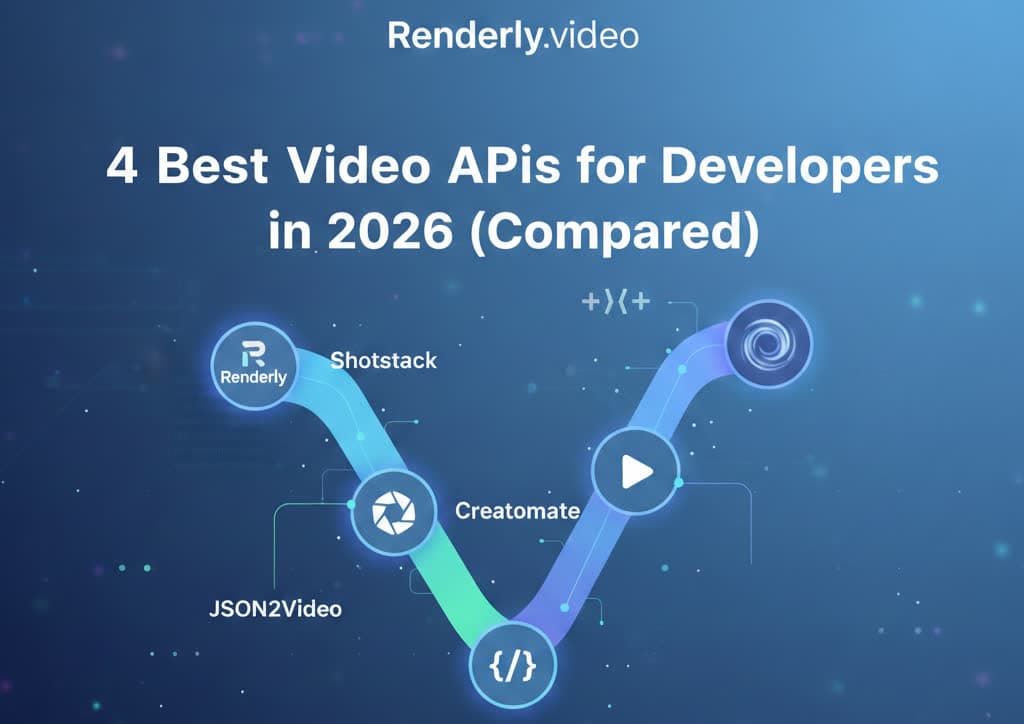
4 Best Video APIs for Developers (2026 Mid-Year Update)
We compared Renderly, Shotstack, Creatomate, and JSON2Video on price, speed, and DX. Subscription costs run $0.10 to $0.84 per minute at 1080p.
June 8, 2026
Video API Pricing Comparison 2026: The Real Cost Per Video
Five video APIs, every rate card re-checked in August 2026. One finished 1080p minute costs $0.10 to $1.38 depending on who you buy it from - and the credit math hides most of it.
August 14, 2026
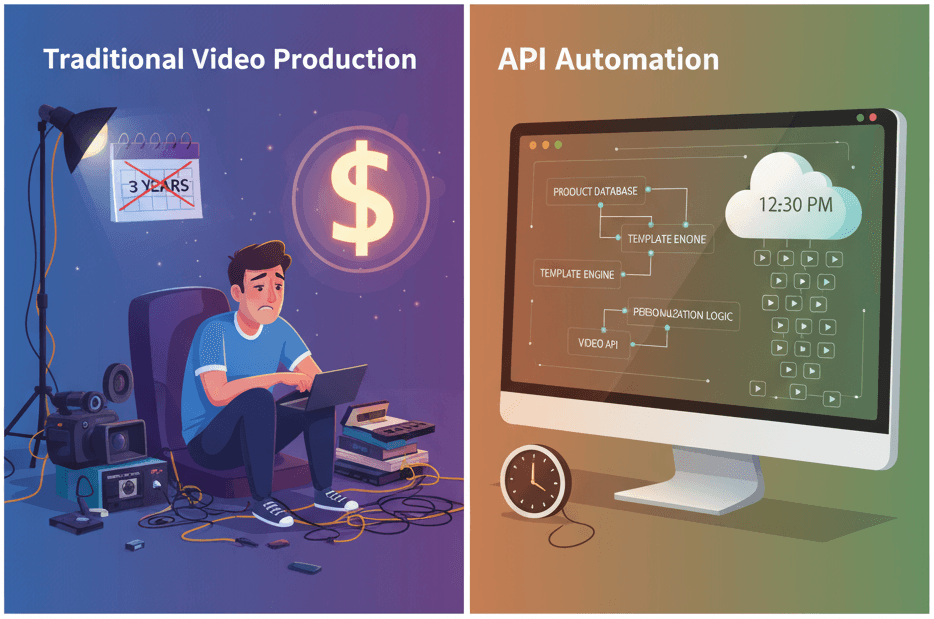
How to Generate 1,000+ Personalized Videos with API Automation (2026 Update)
Personalized videos convert at 3x the rate of generic ones (Tavus, 2025). This developer guide shows how to build a bulk video generation pipeline using REST APIs — 1,000 videos in under 20 minutes at $0.10–0.50 each.
May 18, 2026
The Complete Guide to Automating Video Creation in 2026
Automate video creation in 2026 with templates, APIs, and AI agents. Agency video runs $1,000-7,000/min; template rendering runs $0.10-0.20. The full playbook.
July 28, 2026

Template-Based Video vs AI-Generated Video: Which Should You Choose?
Template video vs AI video in 2026: a 1080p minute costs $0.10-$0.20 to render from a template and $4.80-$24.00 to generate with Veo 3.1. Here's the decision rule.
April 16, 2026