
Personalized Video at Scale: The Complete Guide (2026)
83% of consumers can spot AI video and 36% trust those brands less. Here's how to scale personalized video in 2026 without falling into the avatar trap.

Founder
In 2024, AI avatar video looked like the personalization unlock every marketing team had been waiting for. Drop a script in, get a talking-head clip out, ship it to 10,000 prospects by lunch.
Eighteen months later, the data tells a different story. Nearly 83% of consumers say they have watched a video they suspected was AI-generated, and 36% say an AI-generated video would lower their perception of the brand (Animoto, January 2026). Meanwhile, 80% of consumers want more video from brands and 46% say they never receive any (Idomoo, 2026 State of Video Technology). The demand keeps climbing. The wrong approach now costs more than just rendering time - it costs trust.
This guide maps the 2026 personalized video landscape: what works, what backfires, and how to choose the production approach that fits your team without taking on hidden brand risk. We'll cover the four production architectures, the real cost per 1,000 videos for each, and a starter pipeline you can ship this week.
Key Takeaways
- Personalized video makes someone 3.5x more likely to become or remain a customer, and 80% of consumers want more video from brands (Idomoo, 2025; Idomoo, 2026)
- Nearly 83% of consumers say they have watched a video they suspected was AI-generated, and 36% say it would lower their perception of the brand (Animoto, January 2026) - the production approach is now a brand-trust decision
- The 2026 market splits into four approaches: human-recorded SaaS, AI avatar, no-code templates, and developer-API template rendering
- Template-based rendering costs roughly $50 - $300 per 1,000 videos at the low end and stays brand-consistent at scale - the trust-safe default for most use cases
What Is Personalized Video at Scale?
Personalized video at scale means producing thousands of unique video variants from a single template, with each variant tailored to a viewer, account, listing, or product - without manually editing each one. The unit of personalization can be a name, a CRM record, a property address, a product SKU, or any data field a template can read. The online video platform market is projected to grow from $14.02B in 2025 to $17.08B in 2026, and "demand for personalized video experiences" leads the five growth drivers the report names (Research and Markets, 2026).
There's a useful distinction most articles blur. Personalization is one-to-one - a video where someone's name, role, or company appears because the data said so. Segmentation is one-to-many - a video variant for "enterprise prospects" or "Bay Area listings" or "summer collection." Both qualify as personalization at scale in 2026; the data shape just changes.
The same machinery covers a different unit of variation: not one video per person, but many versions of one message, which is what batch-rendering social ad variants is for.
"At scale" usually starts around 100 variants. That's the point where editing each video by hand stops being viable and templating starts paying off. Past 1,000 variants, manual editing isn't even an option - the entire pipeline has to be automated end to end.
The AI video generator market itself sat at $788.5M in 2025 and is projected to reach $3.44B by 2033, a 20.3% CAGR over 2026-2033 (Grand View Research, 2025). Personalization is one of the largest demand drivers inside that growth.
Why Does Personalized Video Outperform Generic Video?
Personalized video makes someone 3.5x more likely to become or remain a customer, and 4x more likely to feel valued by the brand (Idomoo, April 2025). Read those two carefully, because they are narrower than the versions in circulation: the first folds retention into the number rather than measuring conversion alone, and a third figure from the same study, 3x more likely to trust a brand, is often quoted with "and recommend" appended to it. It does not measure recommendation.
McKinsey's research on personalization economics puts the typical revenue lift at 10-15%, with a 5-25% range depending on sector (McKinsey, 2021). Video accelerates that because it holds attention longer than static creative. The widely-paired claims that personalization cuts acquisition cost by half and lifts marketing ROI 10-30% come from a different McKinsey study published in 2015, whose own revenue range (5-15%) contradicts the 2021 one, so we have stopped quoting the two together.
In outbound sales, the strongest single data point is Vidyard's Terminus case study: a 216% higher response rate, alongside a 40% lift in opens and 37% in click-throughs, after leading with video in prospecting email (Vidyard, undated). Treat it as a vendor-published customer anecdote rather than measurement. It carries no date, sample size or time window, and despite Terminus being an account-based marketing company, the case study describes general first-touch prospecting rather than ABM sequences specifically.
Generation Z reads as an interesting bellwether here. Idomoo's 2026 consumer survey found that people are 4x more likely to prefer a personalized video over a generic one, and 2x more likely to buy from a brand that uses personalization and advanced video tech. Among Gen Z specifically, 92% want more video from brands - a generation that will punish the brands that under-invest (Idomoo, 2026).
The case for personalization is settled. The remaining question is how you produce it - and that's where 2026 has rewritten the playbook.
The Hidden Cost of AI Avatar Fatigue
AI avatar video looked like the obvious unlock when HeyGen, Synthesia, and a wave of startups shipped credible-enough talking-head models in 2024. Two years in, the consumer data is unfriendly: nearly 83% of consumers say they have watched a video they suspected was AI-generated, 36% say an AI-generated video would lower their perception of the brand, and nearly 78% say they trust videos featuring real people (Animoto, State of Video 2026). Note what that last figure is not. It is an absolute measure of trust in real-person video, not a head-to-head against AI-generated video, and it is regularly quoted as though it were. Separately, 88% of consumers say trusting a brand is an important or critical purchase criterion, on par with quality and value (Edelman Trust Barometer, 2026). That figure is Edelman's, not Animoto's, though it circulates attached to the Animoto report.
That's not a one-off survey. The share of consumers who view generative AI as a negative disruptor in the creator economy jumped from 18% in 2023 to 32% in 2025, while consumer enthusiasm for AI-generated creator content fell from 60% to 26% (eMarketer, 2025). The trend line is going the wrong direction for brands that planned to lean on avatars as a default.
Our read: When teams chose AI avatars in 2024, they were optimizing for speed and novelty. In 2026, that same choice quietly costs them on the trust dimension competitors are starting to weaponize. The decision matrix has shifted - the production approach is now a brand-safety call, not just a cost-and-feature call.
This doesn't mean avatars are dead. They still work - and work well - in three contexts. Internal training video, where the viewer knows it's automated and just wants the information. Multilingual localization, where dubbing a real person across 20 languages is more uncanny than a competent avatar. And low-stakes utility content, where the brand-affinity bar is low.
Where avatars are starting to backfire: outbound sales (a synthetic face in a cold email reads as a cheat code), customer-facing brand content (your homepage hero), and any regulated industry where authenticity is part of compliance. In regulated categories the objection usually arrives from compliance and brand rather than from marketing, which is worth knowing before you pilot.
For a fuller breakdown of when each approach makes sense, see our template-based video vs AI-generated video comparison.
The Four Approaches to Personalized Video at Scale
Every personalized-video stack in 2026 falls into one of four production architectures. Each has a sweet spot, a cost profile, and a brand-trust profile worth knowing before you commit.
Human-recorded SaaS (Vidyard, Sendspark, Loom, Hippo Video). A real person records a base clip and the platform inserts personalized text overlays or dynamic intros. Best for: high-ACV B2B sales outreach, account-based marketing, and any deal where one rep can justify a custom take. Failure mode: doesn't scale past human bandwidth. Cost per video is the highest of the four, but the cost per closed deal often wins because reply rates run 5-10x cold-email baseline.
AI avatar (HeyGen, Synthesia, Tavus, BHuman). A synthetic talking head delivers a script, with the face cloned from a real person or selected from a stock library. Best for: internal training, multilingual content, and low-stakes utility. Failure mode: the 36% trust drop we covered above, plus growing detection rates on the consumer side. Cost is moderate - typically $0.30 to $1.00+ per rendered minute via API.
No-code template platforms (Creatomate, Plainly, Bannerbear). A drag-and-drop editor produces a template; non-developers feed it a spreadsheet or no-code workflow; the platform renders the variants. Best for: marketing teams with simple variable substitution (text, logo, color, one media swap). Failure mode: design ceilings - complex motion or branching logic gets clunky.
Developer-API template rendering (Renderly, programmatic pipelines on Remotion). A JSON template defines layers and dynamic slots; an API endpoint accepts variables and returns rendered video. Best for: product features, high-volume catalogs, complex motion, and pipelines that need to live inside your application. Failure mode: needs a developer to set up - though glue tools like Zapier and Make.com lower that bar dramatically.
Template rendering fits the largest share of business video work, because most of it (product, onboarding, real estate, e-commerce, transactional) wants bounded variation with airtight brand consistency. The AI avatar share is real but smaller than 2024 forecasts predicted. We are deliberately not putting a percentage on that split: we have no measurement that would support one, and neither does anyone else publishing this kind of breakdown.
The non-obvious takeaway: the decision isn't "which is best" - it's "which fits this specific workload." Most teams that scale eventually run two of these in parallel, typically a template API for product and marketing video alongside a human-recorded tool for top-of-funnel sales outreach.
How Does Template-Based Personalization Actually Work?
Template-based personalization defines a reusable video "shell" with static branding (logo, colors, fonts) and dynamic slots (text, images, video clips, audio) that get filled at render time from a data source. The same template plus a 1,000-row spreadsheet produces 1,000 unique videos with zero per-video editing.
The mechanics break into three parts: the template, the data binding, and the render pipeline. The template is a structured definition - usually JSON - of layers, timing, and which slots are dynamic. The data binding maps each row of source data to a render request. The pipeline accepts those requests, renders, and delivers the finished files via S3, webhook, or whatever your stack expects.
Dynamic slots aren't limited to what's on screen, either. A sound slot can be filled with AI-generated narration from a per-row script at render time - see how to add an AI voiceover to real estate videos via API for that pattern end to end.
Here's what a personalized video template looks like in Renderly's format, simplified:
{
  "replacements": {
    "headline": "Default Name",
    "background": "default.mp4"
  },
  "overlays": [
    { "type": "text", "name": "headline", "content": "Default Name", "isDynamic": true },
    { "type": "video", "name": "background", "src": "default.mp4", "isDynamic": true },
    { "type": "text", "content": "Static brand footer", "isDynamic": false }
  ]
}The isDynamic flag is the contract. Mark a layer dynamic, give it a name, and the API knows to swap its content at render time. Send { "replacements": { "headline": "Sarah", "background": "sarah-clip.mp4" } } and you get Sarah's personalized video. Send a thousand of those, and you get a thousand videos.
The same model - variable substitution into a structured template - is what powers programmatic video at every serious vendor. The vendors differ on the editor UX, the render engine (Renderly uses Remotion, some use After Effects, others use proprietary engines), and what kinds of dynamic logic they support (conditional layers, looping, data-driven motion). The underlying pattern is identical.
For a hands-on walkthrough of building a 1,000-video pipeline end to end, see how to generate 1,000+ personalized videos with API automation.
Where Personalized Video Wins by Industry
Five industries drive the bulk of personalized video volume in 2026. Each has a different unit of personalization, a different data source, and a different ROI profile worth knowing if you're prioritizing where to start.
Real estate is the largest untapped market. In 2025, NAR's Profile of Home Staging found 48% of buyers' agents said videos in a listing were highly important to their clients (NAR, 2025) - yet video remains the asset most listings skip, because per-property production costs hundreds of dollars. The unit of personalization is the listing itself: address, beds/baths, price, photos. Template-rendered listing videos solve the supply gap - our guide to automating real estate listing videos with an API walks through the full pipeline, MLS field mapping included. The data source is the MLS or a brokerage CRM.
E-commerce turns the cart abandonment problem into a personalization opportunity. Documented online cart abandonment averaged 70.22% across 50 studies as of September 2025 (Baymard Institute, 2025) - a deep pool of warm intent that a generic "you left something behind" email barely taps. A personalized recovery video showing the exact product, restyled per shopper, gives a far stronger reason to return. The unit is the abandoned product; the data source is the cart and product catalog.

B2B sales outreach is where personalized video earns its premium, though the published evidence is thinner than the enthusiasm suggests. Vidyard's Terminus case study reports the 40% / 37% / 216% lifts described above, for first-touch prospecting email rather than ABM sequences specifically (Vidyard, undated). Orum reports a 36% conversion rate on the core call to action using personalized video built with Idomoo (Business Wire, 2026) - but that was a year-in-review recap sent to Orum's existing users, so it measures warm-audience engagement, not cold outbound. Both are vendor-published. The unit is the account; the data is your CRM.
SaaS customer success uses personalized video for onboarding, milestone celebrations, and churn-recovery. The unit is the user account, often filtered by lifecycle stage. Template-based rendering is the standard here because every video needs to match the product UI exactly - avatars and human-recorded clips don't.
Financial services lean hardest into template-based rendering because of compliance. Renewal videos, statement explainers, regulatory communications all need predictable, auditable output. The unit of personalization is the customer record; the data source is the policy or account system. AI avatars are usually a non-starter in this category for the trust reasons we covered earlier.
Each of these has its own deeper treatment: real estate listing videos, e-commerce product video automation, personalized outreach videos that convert, and dynamic video templates.
The vertical playbooks
Industry is one way to slice this. The other is the specific recurring video a team already knows it needs, which is how our how-to library is organised. Each page below is a complete build for one output, with the template and the data wiring:
| The recurring video | Playbook |
|---|---|
| A daily dish or offer | Restaurant daily special |
| One card per fixture | Sports highlight recaps |
| One render per open role | Job ad videos |
| A morning news edition | Daily news videos |
| The recurring social post | TikTok, Instagram Reels, faceless YouTube Shorts |
And if the blocker is getting your data to the renderer rather than deciding what to make, start from the source you already keep it in: Airtable, Google Sheets, Notion, or a plain CSV.
What Does Personalized Video Actually Cost?
Producing 1,000 personalized videos in 2026 ranges from roughly $50 at the low end (template API with light overlays) to $5,000+ at the high end (human-recorded SaaS with manual review). The order of magnitude swing is real - and the right answer depends entirely on what kind of video you're producing and how it monetizes downstream.
The numbers come with two important caveats. First, the human-recorded SaaS range looks worst on paper and often wins in B2B outbound because the cost-per-closed-deal is what actually matters. Spending $4 on a video that closes a $25,000 ARR account is rational; the per-video math is a distraction.
Second, the AI avatar API range underestimates the total cost when you factor in the trust hit on customer-facing campaigns. If avatar-detected video costs you 36% of trust impressions, the effective cost goes up substantially even if the render bill stays low.
Template API pricing is the most transparent of the four. Renderly charges $0.20 per credit, where one credit equals one minute of rendered 1080p video. A 30-second personalized video costs about $0.10 to render. A 1,000-video campaign of 30-second videos comes in around $100 - before any subscription discount. For comparison, most no-code template platforms charge $40 - $250/month subscriptions plus per-render credits, which lifts the per-video price by 2-4x at low volume.
For the full vendor comparison, see video API pricing comparison 2026 and video API vs traditional production cost.
How Do You Build Your First Personalized Video Pipeline?
The shortest path from zero to your first 100 personalized videos in 2026 is seven steps. None of them require code in the basic version. Here's the canonical pipeline most marketing teams ship in a single afternoon:
- Pick the personalization unit. Customer name? Product SKU? Listing address? Account record? Start with the one with the highest expected ROI.
- Design the template. One static brand frame, one to four dynamic slots. Resist the urge to make it cinematic - variation kills production cost.
- Choose your render engine. Template API for highest volume and best per-video economics; no-code platform if your team has zero engineering bandwidth.
- Wire the data source. Spreadsheet, CRM, e-commerce catalog. The trigger that says "render now" usually comes from this layer.
- Connect the glue. Zapier, Make.com, or n8n sits between the data source and the render engine. For most teams, this is where the magic happens.
- Render and deliver. Webhook into your delivery system - email tool, sales platform, CMS, S3 bucket.
- Measure and iterate. Open rate, response rate, conversion - pick one metric and optimize the template against it.
There's a worthwhile asymmetry in the time chart that's easy to miss: avatar APIs and human-recorded SaaS are fastest to first video but slowest to first thousand. Template-based approaches have a higher setup tax but the marginal cost of video #1,001 is essentially zero. If you're scaling past a couple hundred variants, the curve flips fast.

What we've seen: The teams that succeed at personalization at scale almost always start small and ugly - one template, one data source, 100 videos. They iterate on the template once they see real performance data. The teams that fail tend to over-engineer the first version, ship it, and then can't tell which lever to pull when results disappoint. Start simple. Ship. Measure. Then make it pretty.
For a concrete no-code build using Make.com, see how to create automated videos with Make.com. For the broader automation landscape, our complete guide to automating video creation is the sibling pillar that connects all the dots.
Where Personalized Video Goes Next
The next 12 months in personalized video aren't going to be defined by a new architecture - they'll be defined by trust. The Animoto data isn't a one-time blip; consumer awareness of AI-generated content keeps climbing, and the brands that quietly switched to template-based rendering in 2025 are pulling ahead on engagement metrics in segments where avatar fatigue is loudest.
There's a second shift happening underneath the first. Personalization is moving downstream from marketing into product. SaaS apps are starting to ship personalized video as a feature - onboarding clips, milestone celebrations, renewal reminders - rendered inside the product itself. That requires API-first rendering with predictable cost and zero-touch reliability. It's the same lane Renderly was built for, and it's where developer-facing template APIs separate from the no-code crowd.
The teams that win the next year will treat personalized video as infrastructure, not as a campaign tactic. Pick one use case. Build the minimum pipeline. Get the first 100 videos in production. Then expand from there.
If you want to start now: Renderly's template API runs $0.20 per minute of rendered video with no monthly minimum and connects to Zapier, Make.com, and n8n out of the box. Try a free render or read the best video APIs for developers comparison to see how the field stacks up.
Frequently asked
What's the difference between personalized video and dynamic video?
Is AI avatar video bad for my brand?
How many personalized videos can I render per month with a template-based API?
Do I need a developer to produce personalized video at scale?
What's the most cost-effective approach for under 500 personalized videos per month?
Related Articles
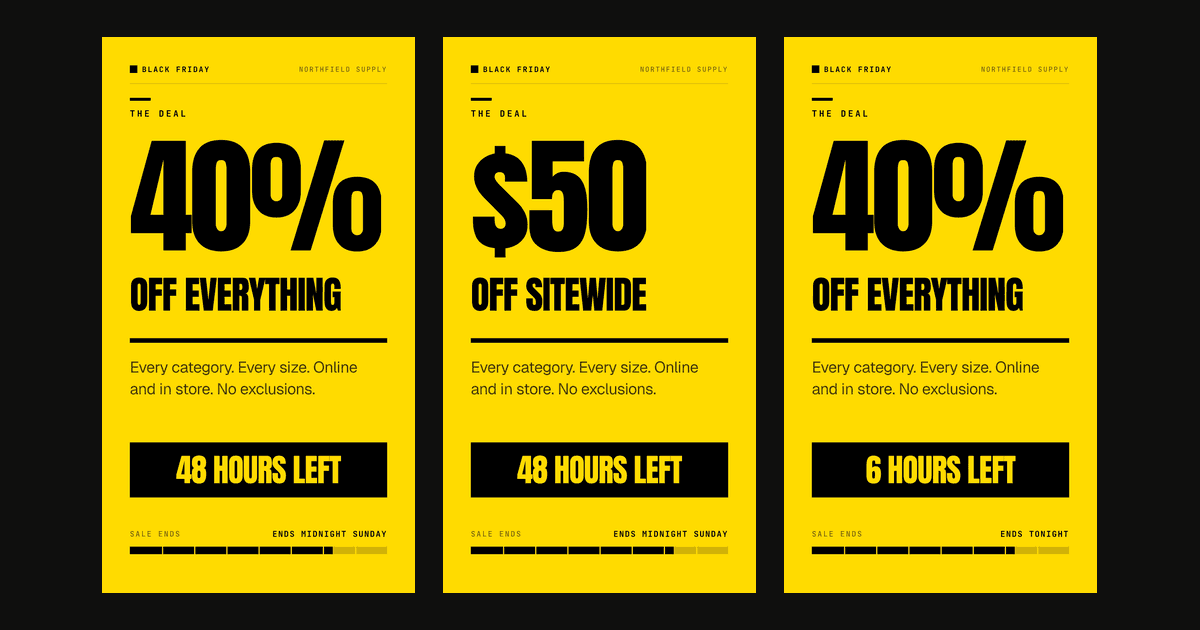
Social Media Video Automation: Batch-Render Ad Variants
TikTok suggests 3-5 creatives per ad group across 3-5 ad groups, so up to 25 videos. We rendered variants of one 9:16 template in 13 to 19 seconds each.
August 20, 2026
Dynamic Video Templates: Variable-Based Video Creation
91% of businesses use video and 82% report good ROI (Wyzowl 2026). Dynamic video templates let you build one design and render thousands of unique videos.
July 16, 2026
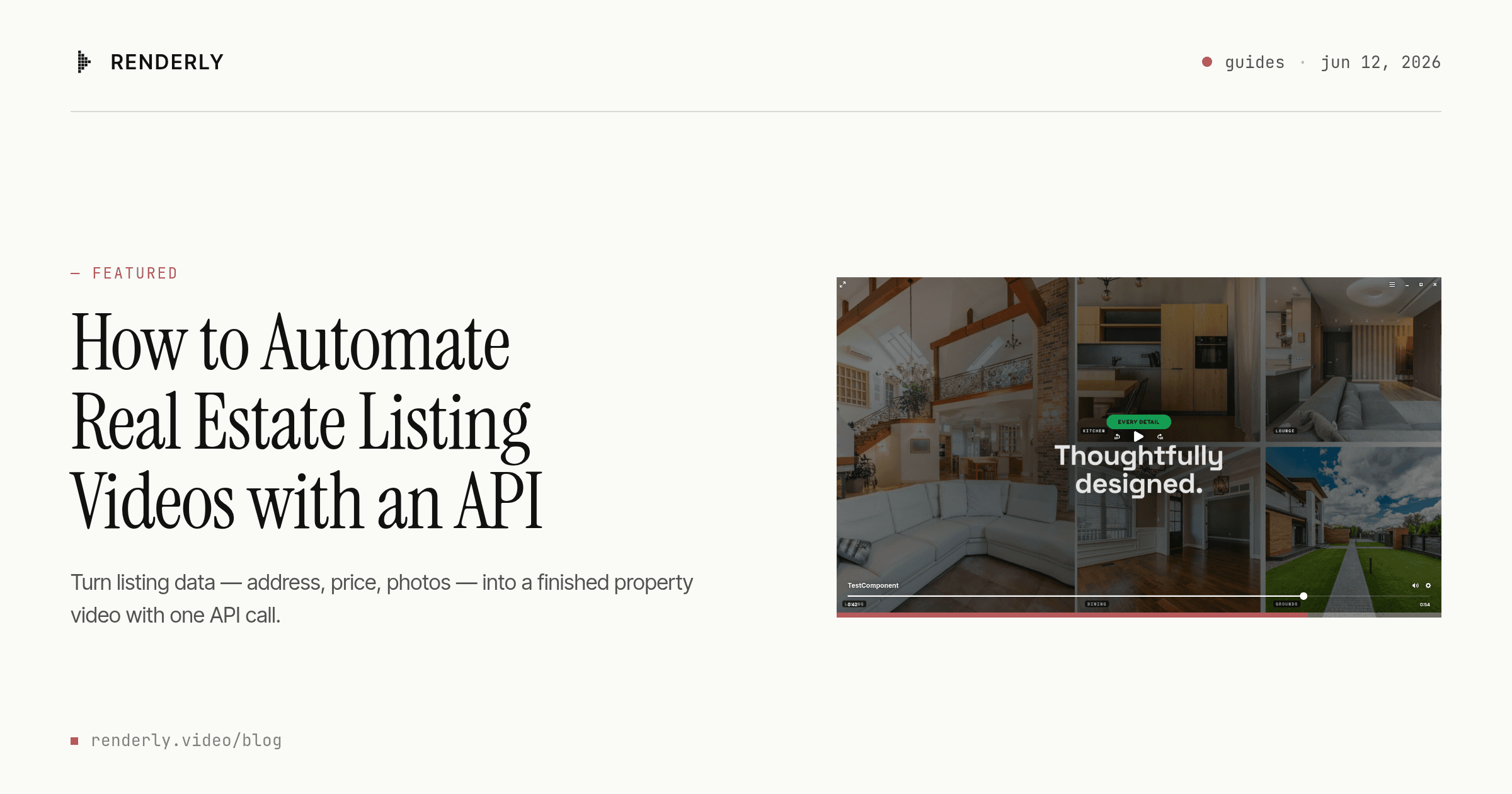
How to Automate Real Estate Listing Videos with an API
474,976 new US listings hit the market in May 2026 — almost none got a video. Here's how to turn listing data into property videos with one API call.
June 12, 2026
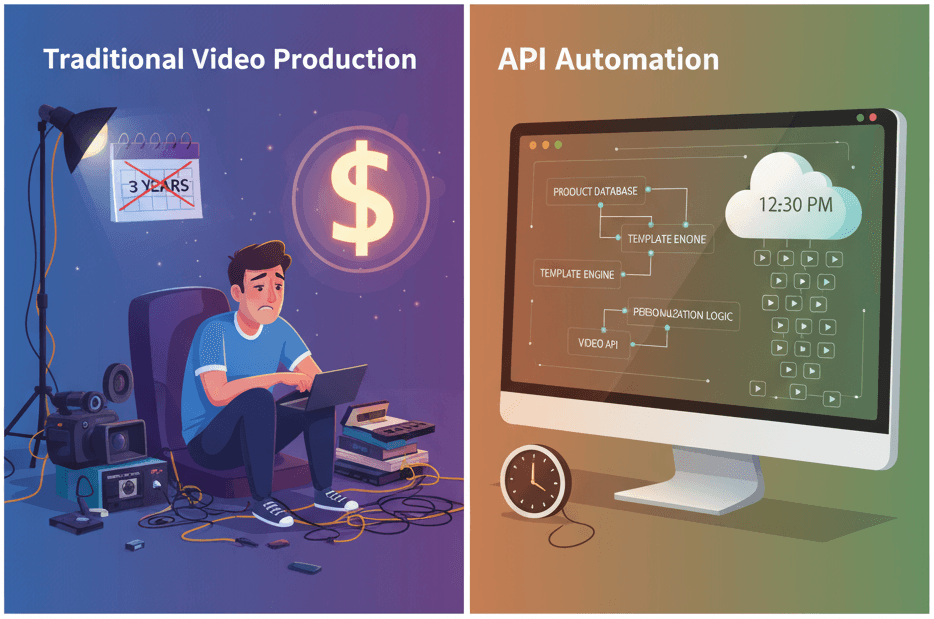
How to Generate 1,000+ Personalized Videos with API Automation (2026 Update)
A 30-second 1080p render costs $0.10 on a template API and $1.50+ on a generative one. Build the bulk pipeline: 1,000 personalized videos queued in under 20 minutes.
May 18, 2026
Template-Based Video vs AI-Generated Video: Which Should You Choose?
Template video vs AI video in 2026: a 1080p minute costs $0.10-$0.20 to render from a template and $4.80-$24.00 to generate with Veo 3.1. Here's the decision rule.
April 16, 2026
The Complete Guide to Automating Video Creation in 2026
Automate video creation in 2026 with templates, APIs, and AI agents. An expert production company charges about $1,000/min; a template render, $0.10-0.20.
July 28, 2026
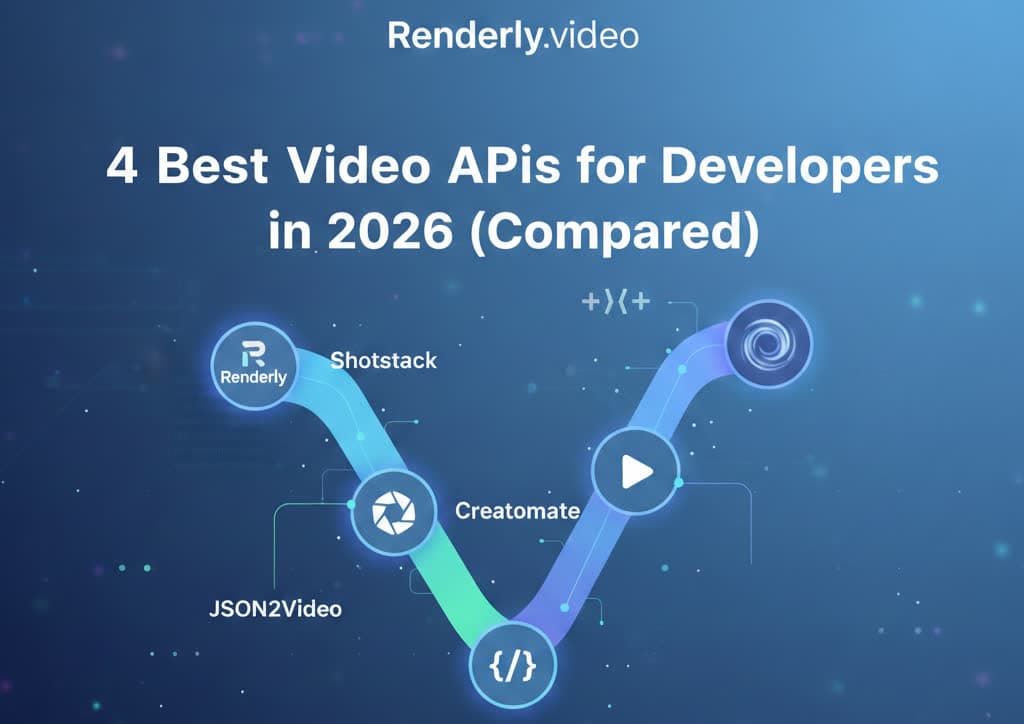
4 Best Video APIs for Developers (2026 Mid-Year Update)
We compared Renderly, Shotstack, Creatomate, and JSON2Video on price, speed, and DX. Subscription costs run $0.10 to $0.84 per minute at 1080p.
June 8, 2026
Video API Pricing Comparison 2026: The Real Cost Per Video
Five video APIs, every rate card re-checked in August 2026. One finished 1080p minute costs $0.10 to $1.38 depending on who you buy it from - and the credit math hides most of it.
August 14, 2026

Video API vs Traditional Video Production: 2026 Cost Comparison
Agency video runs $1,000–7,000 per finished minute (Synthesia, 2025). Template APIs render the same minute for $0.10–0.20. The real cost math, tier by tier.
August 5, 2026